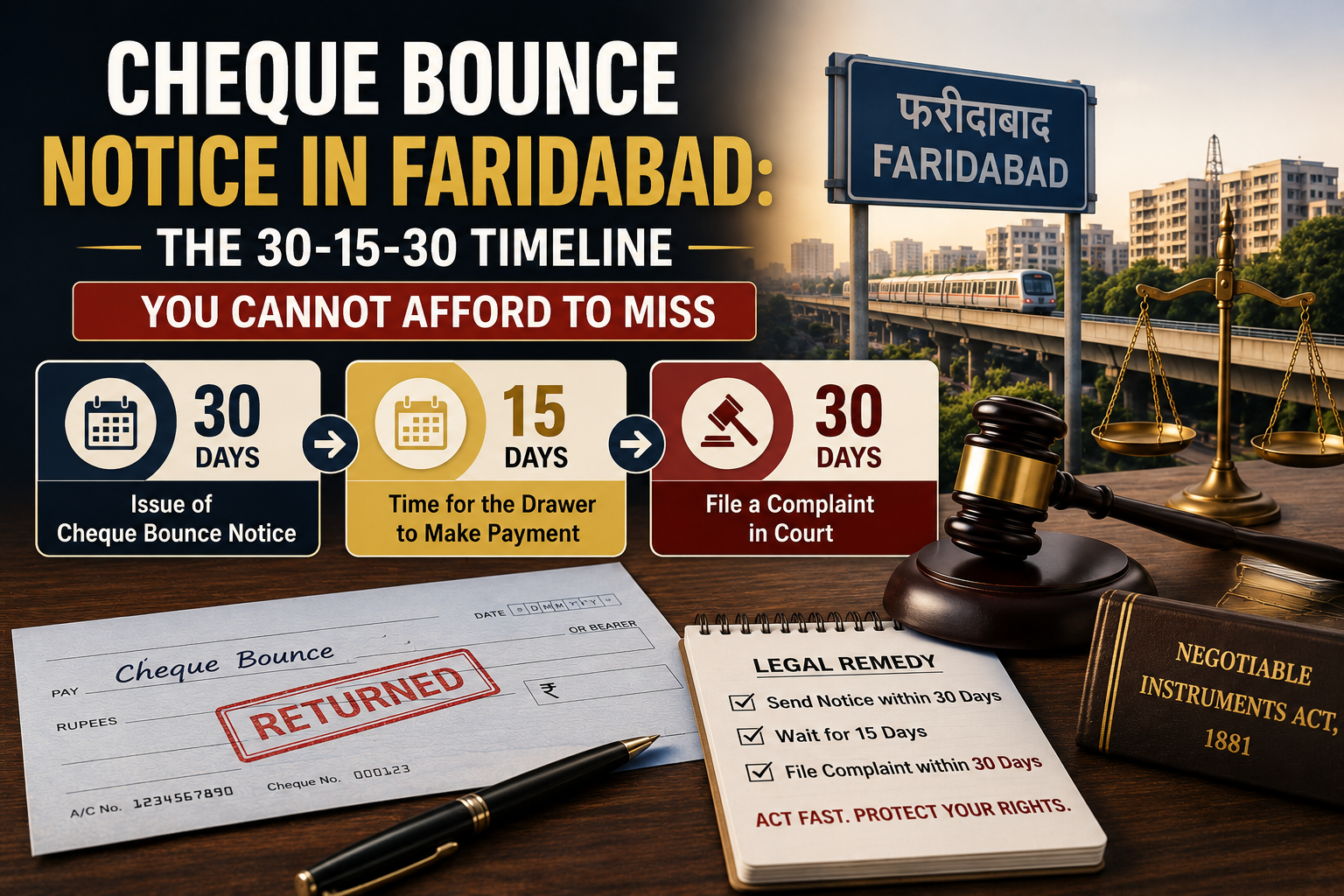
Cheque Bounce Notice in Faridabad: The 30-15-30 Timeline You Cannot Afford to Miss
Someone gave you a cheque. You deposited it. The bank returned it unpaid. Right now, a clock has started running.
You get an SMS. Money has left your account — money you never authorised. Your hands shake. You call the bank and get put on hold.
What you do in the next sixty minutes may decide whether you get that money back.
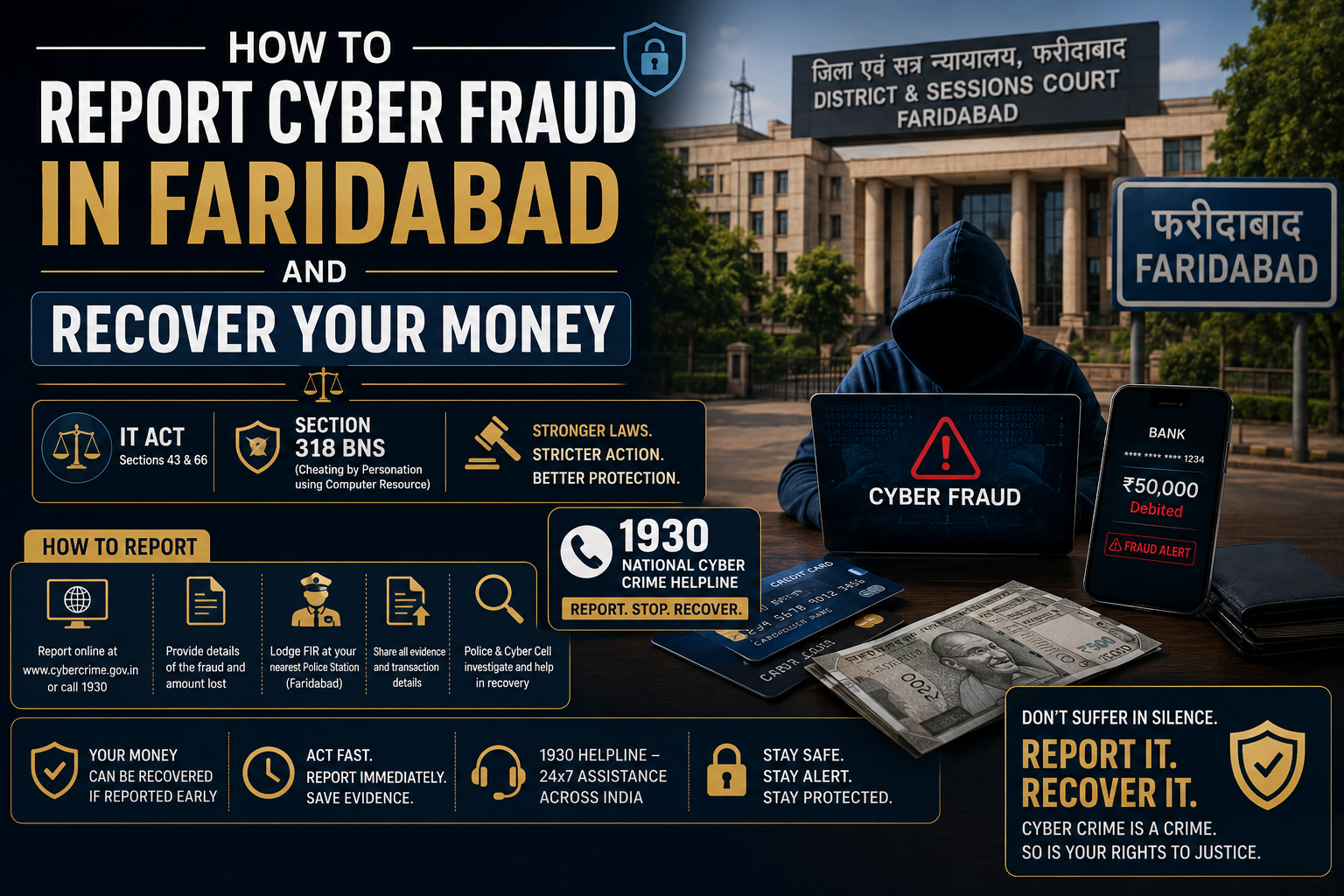
Cyber fraud is now one of the most common complaints in Faridabad, from UPI scams and fake customer-care numbers to digital arrest calls and investment app frauds. The good news is that India has a proper recovery system in place. Most victims simply do not know it exists, or find out too late.
The National Cyber Crime Helpline is 1930. It is toll-free and works across India.
When you report a financial fraud here, the system sends an alert to your bank and to the bank where your money has landed. If the money has not yet been withdrawn, it can be frozen mid-transfer.
This is often called the “golden hour” of cyber fraud. Report within the first hour and your chances are strong. Report within 24 hours and there is still a real chance. Wait a week, and the money has usually moved through several accounts and vanished.
Do not wait to gather documents. Call first, arrange papers later.
Alongside the helpline, register your complaint on the National Cyber Crime Reporting Portal — cybercrime.gov.in.
Keep ready:
You will receive an acknowledgement number. Save it.
This step is separate and equally important. Under RBI’s rules on unauthorised electronic banking transactions, a customer’s liability depends heavily on how quickly the bank is informed.
If you report an unauthorised transaction to your bank within three working days, and the fraud was not due to your own negligence, your liability is generally zero and the bank is expected to credit the amount back.
Delay beyond that, and your liability increases. So send a written email or letter — not just a phone call — and keep proof of it.
If the bank does not resolve your complaint within 30 days, you can escalate to the RBI Ombudsman.
For serious losses, register an FIR at the Cyber Crime Police Station in Faridabad or your local police station.
Two useful things to know under the new BNSS, 2023:
Cyber fraud is usually charged under two statutes together.
Both carry imprisonment of up to three years plus fine.
The IT Act also offers a civil route: under Sections 43 and 46, you can claim compensation before the Adjudicating Officer for damage caused by unauthorised access to your computer or account. Very few victims use this option.
Since 1 July 2024, the IPC has been replaced by the BNS. The key change for fraud victims:
So a typical online fraud FIR today reads as Sections 318 and 319 BNS read with Sections 66C and 66D of the IT Act.
Under the Bharatiya Sakshya Adhiniyam (BSA), 2023, electronic records like screenshots, chat logs and call recordings are admissible — but they generally require a certificate to be produced properly. Preserve originals on the device; do not delete anything.
Cyber fraud recovery is a race against time. Call 1930 first, file on cybercrime.gov.in, notify your bank in writing within three working days, and register an FIR. Each step protects a different right — skipping one can cost you the money.
If the amount is significant or the bank is refusing liability, consult a cyber crime advocate in Faridabad early. The evidence you preserve in the first few days usually decides the case.
Note: This blog is just for educational purposes; it does not act as legal advice. For legal representation, contact a practising advocate. This blog cannot be used as legal evidence or for legal purposes.

 Blog
Blog
Someone gave you a cheque. You deposited it. The bank returned it unpaid. Right now, a clock has started running.
 Blog
Blog
For decades, three characters carried enormous weight in Indian family disputes: 498A. Mention that number and everyone understood — a.
 Blog
Blog
Not every marriage ends in a courtroom battle. Sometimes both people simply accept that it is over, and want to.
 Blog
Blog
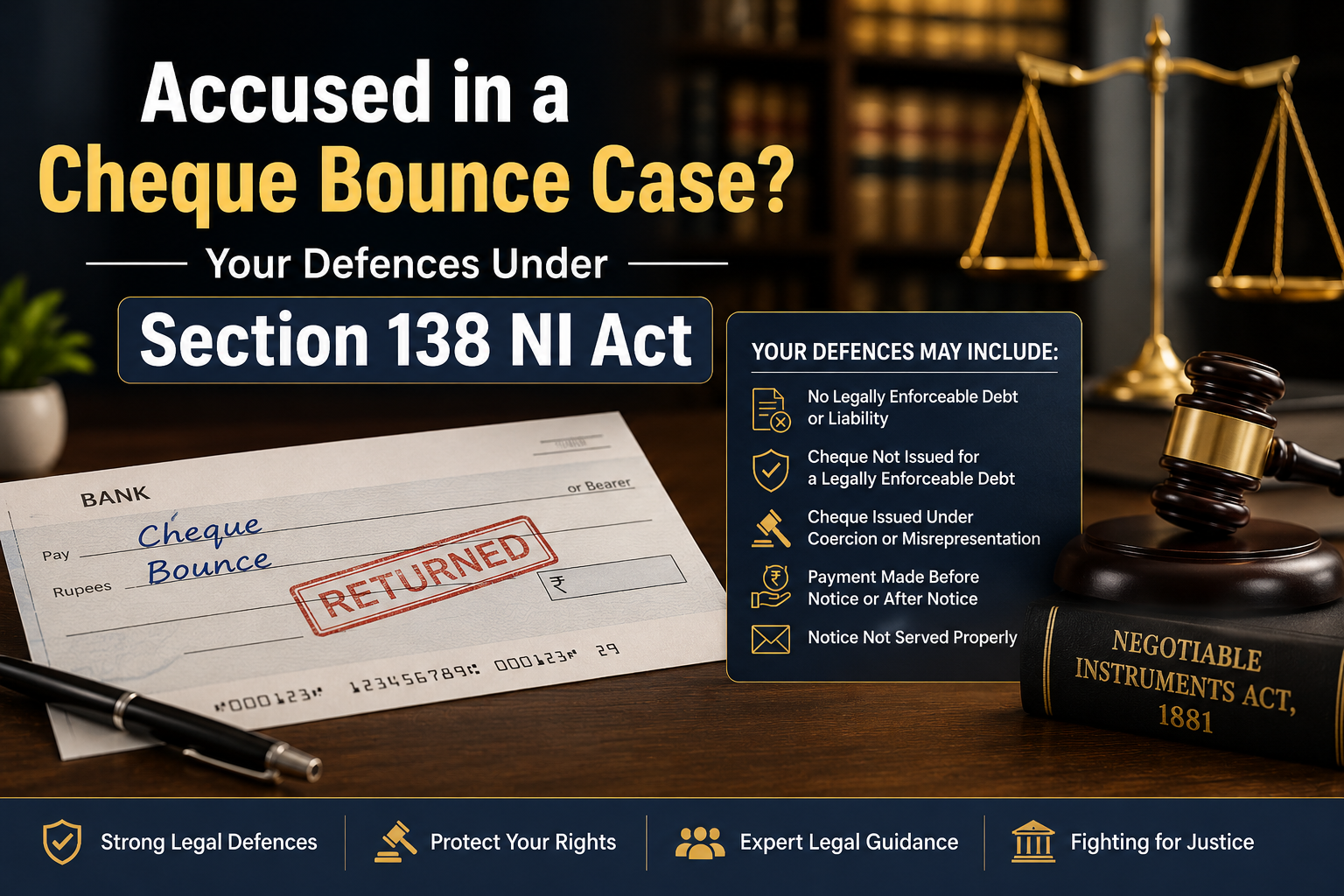
A court summons arrives. Your name is on it, and the words "Section 138, Negotiable Instruments Act" stare back at.
 Blog
Blog
Getting a call that an FIR might be filed against you is frightening. Your mind races. Will the police arrest.
 Blog
Blog
On 1 July 2024, India changed the foundation of its criminal justice system. Three colonial-era laws were replaced: Indian Penal.