Cheque Bounce (Sec 138) vs. Cheating (Sec 420): Can You File Both Cases?
When a cheque is dishonored, the most common question we hear is, "This person has cheated me. Can I file.

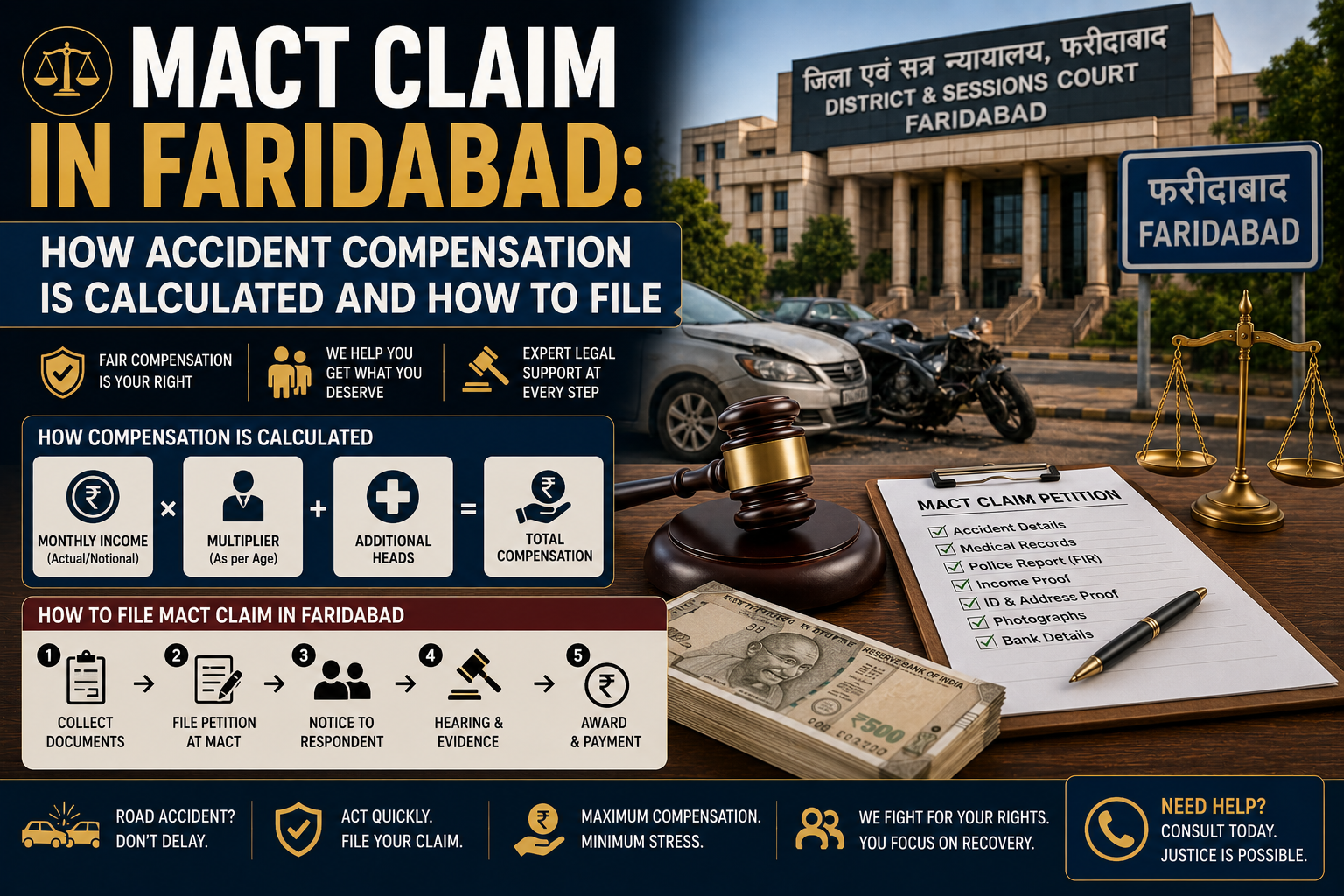
A road accident changes everything in a moment. Hospital bills pile up, the family’s earning member may be gone, and nobody tells you what to do next.
Here is what most people in Faridabad do not know: you have a legal right to compensation, and you do not need to fight a criminal case to get it. That is what the Motor Accident Claims Tribunal (MACT) is for.
Let us break it down simply.
MACT is a special tribunal set up under the Motor Vehicles Act, 1988 to decide compensation claims arising from road accidents. In Faridabad, it functions from the District Court complex and is presided over by a senior judicial officer.
Importantly, MACT is separate from the criminal case against the driver. The police case decides punishment. MACT decides money and it usually comes from the insurance company of the offending vehicle, not from the driver’s pocket.
This is the “no-fault” route. You do not have to prove whose mistake it was. The law gives a fixed amount:
It is faster, but the amount is capped.
This is the route most families choose. Here you claim actual, just compensation based on the loss suffered. There is no upper limit, but you must show negligence on the part of the driver. Awards here often run into lakhs — sometimes crores.
You must choose one route; you cannot take both.
The Supreme Court laid down the formula in Sarla Verma and the Constitution Bench decision in National Insurance Co. v. Pranay Sethi. Tribunals across India, including Faridabad, follow it.
Take the deceased’s or injured person’s yearly income from salary slips, ITR or business records.
Courts assume income would have grown:
(Slightly lower percentages apply for self-employed persons.)
Since the deceased would have spent some money on himself:
A number based on age — 18 for a 25-year-old, 16 at age 35, 13 at age 50, and so on. Younger victims get a higher multiplier.
Fixed amounts for funeral expenses, loss of estate and loss of consortium (companionship), which the Supreme Court enhances by 10% every three years.
A 35-year-old man earning ₹30,000 a month, survived by his wife and two children:
For injury cases, the calculation covers medical bills, loss of actual income, future loss due to disability, and pain and suffering.
You may file the claim before the MACT where:
So if the accident happened elsewhere but you live in Faridabad, you can often file here.
Watch the deadline. Under Section 166(3), a claim application must generally be filed within six months of the accident. Do not sit on your rights.
One more thing worth knowing: under Section 159, the police are required to forward the accident report to the Tribunal, and that report itself can be treated as a claim application — but you should never rely on this alone.
A MACT claim is not charity. It is your legal entitlement, paid mostly by an insurance company that has already collected a premium for exactly this situation.
The mistakes that cost families the most are simple ones: missing the six-month window, accepting a low settlement out of desperation, or filing under Section 164 when Section 166 would have given far more. Preserve every document from day one, and speak to a practising MACT advocate in Faridabad before you sign anything.
Note: This blog is just for educational purposes; it does not act as legal advice. For legal representation, contact a practising advocate. This blog cannot be used as legal evidence or for legal purposes.

When a cheque is dishonored, the most common question we hear is, "This person has cheated me. Can I file.
Finding a divorce lawyer is not like any other legal search. A divorce is one of the most personal and.
Employee documentation is no longer just an internal HR practice—it is now a legal requirement with serious compliance implications. Recent.
The introduction of the Bharatiya Nyaya Sanhita (BNS) has brought new laws and, with them, a lot of new questions.
With the November 2025 labour law shift approaching, one question is on everyone’s mind: Will my take-home salary decrease? News.
This is one of the most common questions people ask when facing a marital breakdown. The idea of navigating courtrooms.